
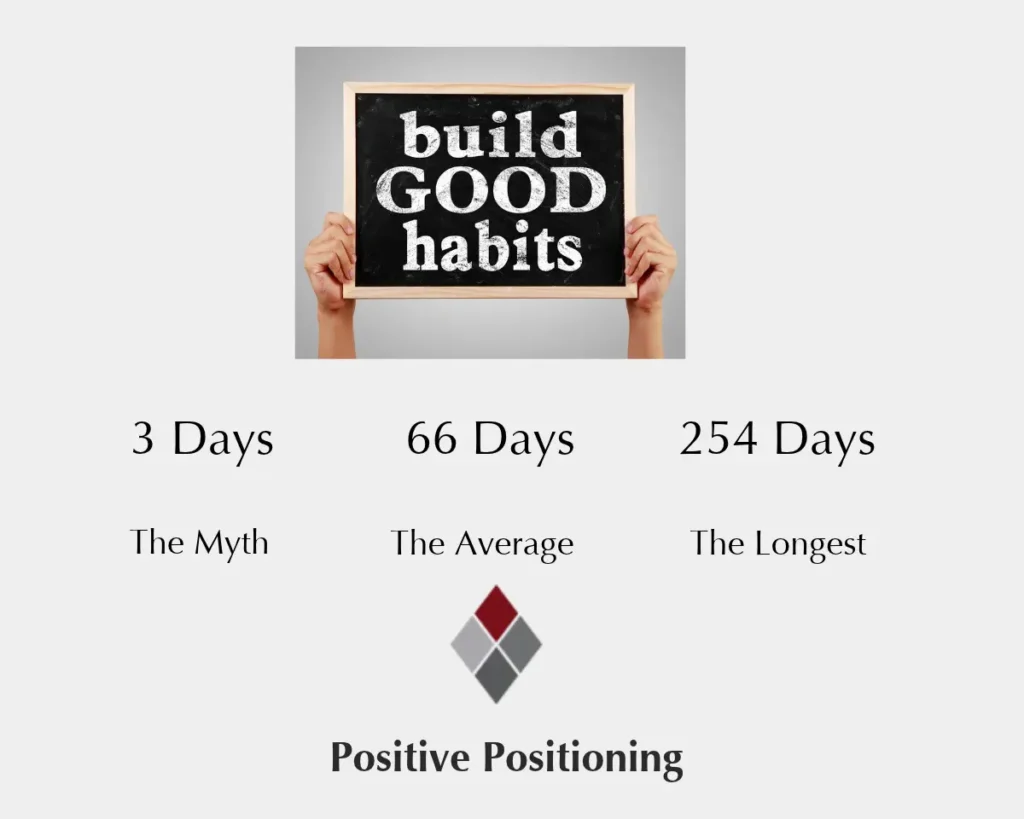
Someone once told me it takes three consecutive days to form a habit.
I remember how excited I got. This is great news, I thought. Three days? I can do three days. I’ll be well on my way.
Well, if it were that easy, we would all have our hopes and dreams fulfilled by Thursday.
The Three-Day Promise
Three days isn’t even the most popular version. The one most of us have heard is 21 days. That number traces back to a 1960 book by a plastic surgeon, Maxwell Maltz, who noticed his patients needed about three weeks to adjust to a change. Somewhere along the way, “about three weeks to adjust” became “21 days to form a habit,” and a myth was born.
The research tells a different story. In a 2009 study at University College London, researchers followed people as they tried to build a new daily behavior: eating a piece of fruit with lunch, going for a run before dinner. On average, it took 66 days for the behavior to become automatic. The range? Anywhere from 18 to 254 days.
Two hundred and fifty-four days. That’s not a temporary assignment. That’s most of a year.
It’s not that change isn’t possible. It’s that the odds of slipping away from consistency are a strong bet. So why do we put so much pressure on ourselves?
I think it’s because a timeline makes change feel manageable. But when we set a goal to do something consistently and put a deadline on it, it becomes a temporary assignment, something to get through, rather than a change in lifestyle or behavior. And when we slip on day four, it’s easy to decide we failed the assignment and quit.
I Didn’t Recognize the Person in the Photo
About 15 years ago, I was on vacation with my family in the Caribbean. Beautiful place, beautiful week. Then I saw the photos, and I didn’t recognize the person in them.
That was all the motivation I needed. I joined a gym.
Three consecutive days turned into five days a week. And somewhere along the way, it stopped being a habit I was trying to build, or a temporary assignment to change how I felt and looked. It became a lifestyle.
It helped that I’m competitive by nature. Every workout became a competition with myself: how much more can I accomplish this time?
Was it hard? Yes. It was not a walk in the park. When I traveled for business, workout gear went into the bag, and running shoes always came along. They’re practical for all that walking in and out of airports anyway. Anyone who has made a tight connection at O’Hare knows exactly what I mean. On vacation, I switched it up and counted the steps, or shall I say miles, I walked each day.
Then COVID closed everything, and my gym was gone overnight. It was the one time it felt like my routine had been taken away from me. So I built a new one at home, with YouTube and the basic equipment I had in the house. It wasn’t the same. It didn’t need to be.
Interestingly, that same UCL study found that missing a single day didn’t meaningfully set people back. Consistency mattered. Perfection didn’t.
Today, skipping a workout feels like skipping brushing my teeth. It simply isn’t an option.
That’s the part no timeline captures. What started as a habit became a lifestyle. People can change their behavior and create new habits, and when that change is positive and you keep choosing it, it becomes a lifestyle.
Reps, Not Perfection
When I started to feel better physically and saw the habit idea working, I began applying it to my work.
At the time, I was leading an Account Management team, and client reporting and presentation reviews were a focal point. I always completed my assignments, but perfection got in the way at times. One more pass on the report. One more round of edits on the deck.
So I started drawing on the reps I did in the gym. Those reps weren’t perfect. Some days I didn’t have the same energy as the day before, and I didn’t work as hard. But in the end, there was always a feeling of completion, followed by a quick review of what I could work on to improve next time.
What helped most was one question. When I catch myself obsessing over the process instead of focusing on the result, I stop and ask: What is the goal?
I have a friend and colleague who does this better than anyone I know. Instead of getting lost in the minutiae chasing perfection, the focus always comes back to the goal. The work gets done, and it gets done well.
If we approached our work habits the way we approach a workout (show up, do the reps, review, adjust, come back tomorrow), think about how satisfying that could be.
The reps at work were never going to be perfect, any more than the reps at the gym were. But they added up. Over time, finishing the work, reviewing it, and moving forward stopped being something I had to remind myself to do. It became simply how I work. That’s the difference between a habit and a lifestyle: a habit is something you remind yourself to do, and a lifestyle is something you would never think to skip.
Reflections:
A few questions worth sitting with:
What habit are you trying to build? Consider what would change if you treated it as a lifestyle instead of a temporary assignment.
Where is perfection slowing you down? Think of the report, the presentation, or the decision you keep reworking one more time.
What’s your version of “What is the goal?” Find the question that pulls you out of the minutiae and back to what actually matters.
If this resonated, I explore ideas like this every month in The Reframe, my newsletter on mindset, motivation, and leading with intention. Subscribe to The Reframe below.
Until next time, — Michele Delgado, Founder Hartmetrics