
Shifting Perspectives: The Art of the Pivot
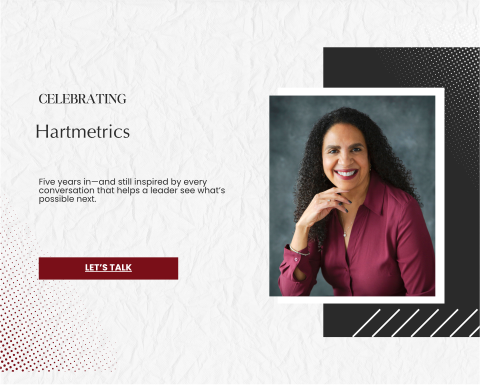
January 2026, marked five years that I founded Hartmetrics and the evolution in the work I do.
Five years ago, I took a leap during a year of uncertainty. The pivot was not just professional-it was personal, deliberate, and necessary. Like many leaders who have faced inflection points, I had a choice; resist the change or lean into it with intention.
I chose the latter. And that choice has shaped everything since.
The Power of Intentional Pivoting
The name Hartmetrics was never arbitrary. Hart comes from my mother’s maiden name. She was a powerhouse woman, an executive coach, and someone who deeply shaped how I view growth and resilience. Metrics reflects my curiosity and love of understanding what’s working, what isn’t, and what needs to shift.
Together, Hartmetrics represents the balance I believe matters most: insight paired with evidence. Data without wisdom is noise. Wisdom without data is guesswork. Leaders who pivot successfully understand both.
That belief is reflected in the logo. The diamond represents a paradigm: rotate it, change your angle, and you see something different. The challenge stays the same; the perspective shifts. This is the essence of pivoting—not running from difficulty, but choosing to view it through a lens that reveals opportunity.
When Pivoting Becomes Necessary
In early 2020, we watched the hospitality industry get rocked to its knees. While not the first crisis the industry had faced, this was a world catastrophe at a whole new level. Having had experience with pivotal change, I was prepared to respond to the challenge.
Two things became immediately clear:
First, I needed to reinvent myself and embrace change rather than resist it. Second, my plan to rebound had to align with my mission to rebuild and support others to do the same.
This is the leader’s dilemma during times of disruption: How do you pivot without losing sight of your core mission? How do you adapt without abandoning the values that define you?
The answer lies in understanding what pivoting actually means.
What Pivoting Isn’t
Let me be clear about what pivoting is not:
It’s not abandonment. A pivot isn’t running away from your purpose or throwing out everything you’ve built. It’s a strategic redirection that keeps your foundation intact while adjusting your approach.
It’s not reactionary scrambling. Panic-driven change rarely creates sustainable results. True pivots are deliberate, even when they’re executed quickly.
It’s not a one-time event. Pivoting is a leadership skill, not a crisis response. The most effective leaders I’ve worked with over the past five years treat pivoting as an ongoing practice, not an emergency measure.
The Framework for Positive Positioning
Through my work with my clients, I’ve identified a clear pattern: the leaders who consistently move from challenge to opportunity aren’t just optimistic—they’re intentional. They’ve built a framework for how they position themselves, their teams, and their challenges.
Out of this work, I began to outline something new. Introducing Positive Positioning—a structured approach to leading from clarity instead of chaos.
It’s built on four pillars that support effective pivoting:
1. Mindset – The Foundation of Adaptive Leadership
Self-care isn’t selfish. You can’t lead effectively if you’re running on fumes, and you certainly can’t pivot with clarity when you’re depleted.
Before the pivot, assess your capacity. Are you making decisions from a place of strength or exhaustion? The quality of your pivot depends on the quality of your thinking, and your thought process depends on how well you’re taking care of yourself.
Leaders who successfully navigate transitions build reserves before they need them. They understand that pivoting requires energy, focus, and resilience—resources that evaporate when you’re operating in constant overdrive.
2. Motivation & Discipline – What Carries You Through Uncertainty
Here’s a truth that took me a long time to accept: motivation is unreliable. It’s wonderful when it shows up, but it’s a terrible foundation to sustain.
Discipline is what shows up when motivation doesn’t.
When you are mid-pivot, motivation will fail you. There will be days when the new direction feels harder than staying the course. There will be moments when you question whether the change was worth it.
This is where discipline becomes your competitive advantage. The leaders I work with who execute pivots successfully don’t wait to “feel ready.” They build systems, routines, and accountability structures that carry them forward even when enthusiasm wanes.
3. Curiosity – The Skill That Reveals Hidden Opportunities
Leaders who stop asking questions stop growing. Pivoting requires intellectual humility—the willingness to admit you don’t have all the answers and the curiosity to seek them out.
When I founded Hartmetrics five years ago, I didn’t have a perfect roadmap. What I had was a willingness to ask: What is my market actually needing right now? Where are the gaps between what exists and what’s possible? Why are traditional approaches falling short? (Spaghetti against the wall)
Stay open. Ask what, where, and why. The answers will guide your pivot more reliably than any predetermined plan.
Curiosity also protects you from one of the biggest pivot pitfalls: assuming you know what your clients, team, or market needs without asking them directly. The leaders who pivot successfully are the ones who stay in conversation with reality, not theory.
4. Action – Strategy Without Execution Is Just Planning
You can have the clearest mindset, the strongest discipline, and the deepest curiosity, but without action, nothing changes.
Plan deliberately, then move and don’t be thrown off when plans don’t work out the first time. Pause and reassess.
One of the patterns I see repeatedly in struggling leaders is paralysis by analysis. They overthink the pivot. They wait for perfect conditions. They delay until they have absolute certainty.
Meanwhile, their more successful counterparts are taking informed action, learning from the feedback, and adjusting as they go. They understand that pivoting is a process of trial and adjustment—you don’t need to know every step before you take the first one
The key is distinguishing between reckless action and strategic experimentation. Reckless action ignores evidence and feedback. Strategic experimentation creates small tests, gathers data, and makes adjustments based on what you learn. (A/B testing)
The Leadership Tax of Not Pivoting
The lesson-When leaders resist necessary pivots; they don’t just miss opportunities—they create patterns of stagnation that ripple through their entire organization.
I see this manifest in several ways:
Celebrating wins becomes impossible. When you’re stuck in outdated approaches, even genuine successes feel hollow because you know they’re not sustainable. As a hyper-achiever, I rarely pause long enough to feel my wins. I minimize the accomplishment and move straight to the next challenge. “So what?” “What’s the big deal?” “Who cares?”
Sound familiar?
Negative self-talk becomes the default. When we don’t celebrate our wins, we don’t just rob ourselves of a moment of satisfaction. We create a pattern. The story we tell ourselves shifts from “I’m capable of adapting” to “I’m falling behind.” And as leaders, that inner narrative doesn’t stay private—it shapes how we show up, how we see others, and how we make decisions.
Envy and judgment creep in. When you’re stuck while others are moving forward, it’s human nature to question their success. “Who do they think they are?” becomes a defense mechanism against your own discomfort with stagnation.
The story we tell ourselves about our capabilities directly impacts our leadership effectiveness. Leaders who pivot successfully maintain a narrative of agency and growth. Leaders who resist pivoting slip into narratives of victimhood and limitation.
Recognizing When It’s Time to Pivot
Not every challenge requires a pivot. Some difficulties are meant to be worked through with persistence, not circumvented with change. So how do you know when a pivot is necessary?
Watch for these signals:
Your current approach is producing diminishing returns. You’re working harder but achieving less. The tactics that used to work have stopped delivering results, and doubling down only accelerates the decline.
Your market has fundamentally shifted. The needs, expectations, or behaviors of your clients, customers, or stakeholders have evolved in ways that make your current offering less relevant.
You’ve outgrown your own model. Sometimes the pivot isn’t about market forces—it’s about personal evolution. The work that once energized you now feels constraining. You’ve developed new skills, insights, or passions that don’t fit within your current structure.
There’s a persistent gap between your mission and your execution. You know what you’re meant to be doing, but your daily reality doesn’t align with it. This misalignment is often the clearest signal that a strategic pivot is needed.
The Mechanics of a Successful Pivot
Based on my work with leaders navigating transitions, here’s what successful pivots have in common:
They start with clarity about what stays. Before you pivot, identify your non-negotiables—the values, relationships, or aspects of your work that define who you are. These anchors keep you grounded as everything else shifts.
For me, that anchor has always been my mission: helping my clients discover ways to implement systems in order to achieve their desired outcome for positive growth. The methods have evolved, but the mission remains constant.
They involve difficult conversations. You’ll need to communicate the change to stakeholders—team members, clients, partners—who may be invested in the status quo. Transparency about why you’re pivoting and where you’re headed builds trust even when the change creates discomfort.
They require letting go. Every pivot involves releasing something—a revenue stream that no longer aligns, a client relationship that’s holding you back, an identity that you’ve outgrown. This is often the hardest part, but it’s non-negotiable.
They create space for experimentation. The best pivots aren’t rigid plans—they’re directional choices that allow for learning and adjustment. Give yourself permission to test, fail, and refine.
What’s Next for Hartmetrics (and What It Means for You)
To celebrate this five-year milestone and welcome 2026, I’ve launched:
- A brand-new website with updated resources and tools designed specifically for leaders navigating complexity, transition, or growth
- Positive Positioning as a formal coaching program that brings structure to the perspective-shifting work I’ve been doing for years
- And giving the newsletter a new name: The Reframe
This perspective-shifting work has always been at the heart of my message. Now, it simply has a name that reflects its purpose.
The Reframe is about pausing, looking again, and choosing a perspective that brings clarity and possibility as you move into what’s next. It’s about developing the skill of pivoting—not as a crisis response, but as a core leadership capability.
Because here’s what I know after years of this work: the leaders who thrive aren’t the ones who never face challenges. They’re the ones who’ve developed the frameworks, mindsets, and disciplines to pivot effectively when challenges arise.
Let’s Reflect
As you step into the new year, I invite you to reflect on these questions:
What win are you not celebrating? Even the smallest victory delivers a quiet charge: I did what I set out to do. Give yourself permission to feel it before moving to what’s next.
What story are you telling yourself about your capabilities? Is it based on facts, or on doubt? And how is that story shaping the way you lead?
Where in your leadership could a shift in perspective unlock a new possibility? What challenge might look different if you rotated the diamond and viewed it from another angle?
What framework are you using to turn your challenges into opportunities? If you don’t have one yet, let’s talk.
I believe everyone should be acknowledged for their talents and encouraged to pursue their dreams regardless of their resources. As the daughter of a single mom and the proud proprietor of Hartmetrics, I encourage other women to be bold in taking their rightful place in the boardroom.
Pivoting isn’t about having all the answers. It’s about having the courage to ask better questions and the discipline to act on what you discover.
Here’s to five years, to the power of shifting perspectives, and to your next strategic pivot.
Until next time,
Michele