
What leaders often miss.
816 words · 4 min read
Difficult conversations leadership is a skill most leaders underestimate. They know hard conversations are inevitable — but knowing that doesn’t make them easier. What often gets overlooked isn’t the conversation itself — it’s everything happening in the room around it. This month’s Reframe looks at what shifts when you move your focus from what you’re going to say to what the other person needs to hear. And if you’re navigating a hard conversation right now, there’s a free resource at the end of this post.
“We Need to Talk”
I’ve been on both sides of that sentence — as the person receiving it and as the person who had to say it. Neither seat is comfortable.
Six years ago, I heard those words and felt everything shift. My stomach dropped. My mind started writing a story before another word was spoken. The silence in that pause felt like several minutes had passed. By the time the actual conversation began, I was already somewhere else — bracing, defending, preparing for whatever was coming.
Like many people who’ve been through something hard, I went through a full range of emotions. And I can say today that I am thriving. But I still think about how differently that conversation could have gone — for both of us.
What’s Happening on Both Sides of the Table
When we prepare to deliver difficult news, we run through the script in our heads. We rehearse the words, anticipate the reaction, and somewhere in that mental noise the last thought becomes: Let me just get through this.
That rehearsal is natural. But it rarely accounts for the person on the other side.
They don’t know what’s coming. Until they hear shut the door or find an unexpected meeting on their calendar, they’re going about their day — and then everything shifts.That’s a different kind of preparation. And it changes everything.
The question isn’t just what do I need to say. It’s: what does this person need in order to actually hear me?
That’s a different kind of preparation. And it changes everything.
The Signals Most Leaders Miss
Here’s what I’ve observed coaching leaders through difficult conversations: the words are rarely the problem. It’s everything happening around the words. The crossed arms that signal defensiveness — or self-soothing. The eye contact that disappears mid-sentence. The long pause after you’ve said something significant. The flat, clipped response that sounds like dismissal but might be someone trying to hold it together.
These signals are easy to miss when you’re focused on what comes next in your script. But they tell you everything about where the other person actually is.
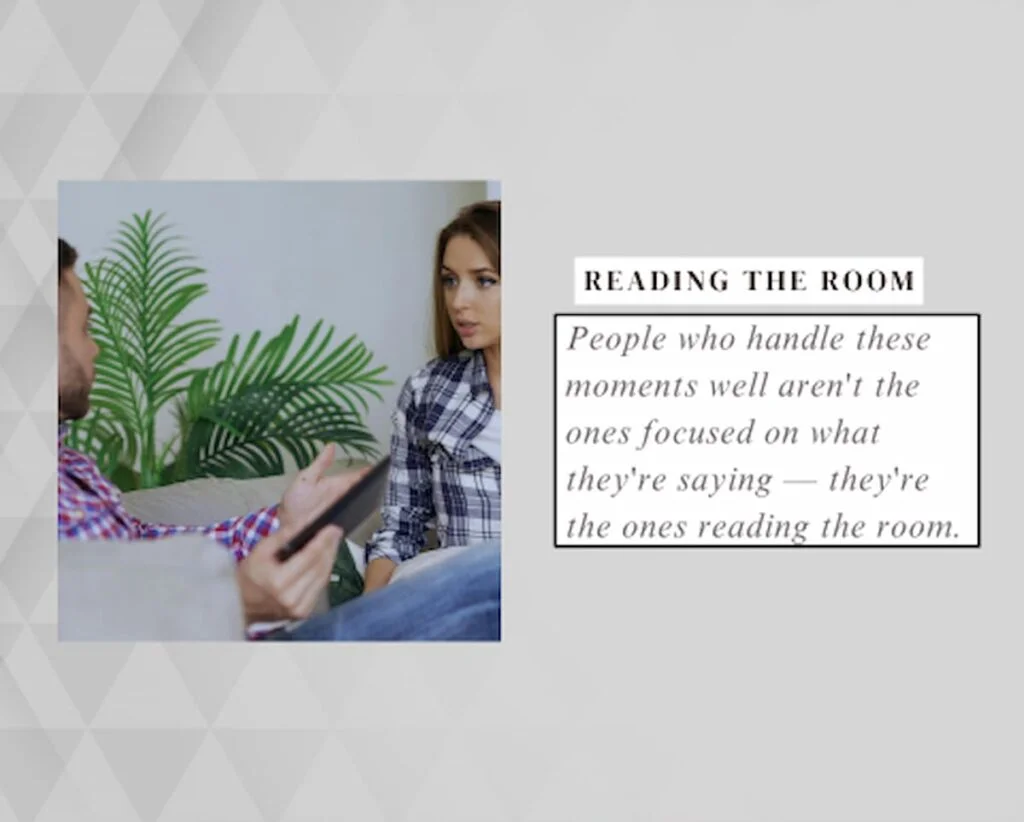
The leaders who handle these moments well aren’t the ones focused on what they’re saying — they’re the ones reading the room. Catching the body language, the vocal shifts, the silence that tells you someone is no longer fully present. And knowing how to respond to those signals without losing the thread of the conversation.
Empathy Isn’t Soft. It’s Strategic.
There’s a belief in a lot of leadership cultures that showing empathy makes you appear weak — that pausing to check in with someone’s emotional state signals you don’t have control of the room.
Not everyone prepares for a difficult conversation the same way. Some rehearse every word. Others decide to just rip the band-aid off and get it over with. What both approaches can miss is the other person’s experience in real time.
The leaders who repair relationships through difficult conversations — who maintain trust even when the news is hard — are the ones who stay curious.
Who slow down instead of pushing through. Who treat the conversation as something to navigate together, not something to deliver and survive.
Showing empathy in a difficult conversation isn’t weakness. It’s what supports the conversation to be most impactful.
A Resource I Built for This
I created Reading the Room as a practical guide for exactly these moments. It’s free, and it covers:
The body language signals to watch for in person — and what they may actually mean
Vocal and behavioral cues to listen for on phone and virtual calls
Specific language to use when the conversation starts to go sideways
How to hold space for a hard conversation without losing your footing as the leader
Leading with Curiosity
Starting any difficult conversation is not easy. If it was, we could delete the word difficult.
But curiosity changes the dynamic before you ever say a word. Instead of walking in focused on what you need to deliver, try getting curious first.
Ask yourself:
- What do you want the person to understand?
- What is the goal of this conversation?
- What do you hope the outcome will be?
Those three questions shift you from delivering a message to leading a conversation.
Reflections:
When have you been the receiver of a difficult message? What do you wish the other person had known?
As a leader, how much of your preparation for hard conversations focuses on delivery — and how much on the other person’s experience?
What would change in your leadership if you walked into every difficult conversation with curiosity instead of a script?
One more thing.
If you’re in the middle of a difficult conversation — or about to have one — you don’t have to navigate it alone. That’s exactly what coaching is for.
Reading the Room
If any of this resonates, here’s where to go deeper
Staying calm when a conversation gets loud
Rebulding trust after it’s been shaken
Negotiating the terms of your own career
Michele Delgado Executive Coach, on a mission